Security Fencing Contractor GTA | Chain Link, Omega & More
Security Fencing for Commercial Properties in the GTA: Chain Link, Omega, and Expanded Metal Explained
Overview
A security fencing contractor in the GTA has to do more than put up a chain link perimeter and call it a day. Commercial and industrial properties need fencing that meets higher standards, from post depth and material gauge to topper type and proper tensioning. Fencecore Inc. has installed security fencing to the standard required by Pearson International Airport, and brings that same level of precision to warehouses, commercial lots, and institutional facilities across Brampton, Toronto, and the wider GTA. If your property needs a perimeter that actually functions as a deterrent, the details matter, and this is where most contractors cut corners.
Get a quote from Fencecore Inc. for security fencing in the GTA — we cover an 80km radius from Brampton.
What Makes Fencing "Security Grade" in Ontario
Material Gauge, Post Depth, and Proper Tensioning
Security grade fencing starts with the basics most contractors rush through. Chain link gauge matters. Residential installs often use 11 or 11.5 gauge wire, but commercial and industrial security fencing should run 9 gauge or heavier. Posts need to sit below the Ontario frost line, which means four feet of depth minimum in this region. Anything shallower will heave during the spring thaw and pull the entire fence out of plumb within a season or two.
Tensioning is where a security fence either holds up or sags. Properly tensioned chain link should have almost no give when pressed. Loose fabric is the first sign of a cheap install, and it is also the easiest point of failure for someone trying to get through the perimeter.
Toppers: Barbed Wire, Razor Wire, and Deterrent Options
The top of the fence does most of the deterrent work. Barbed wire is the standard commercial topper, typically three strands angled outward on a 45-degree arm. Razor wire is a step up for industrial and high-security sites where the threat of intrusion is serious. There are also rotating spike bars, anti-climb finials, and concertina coils for facilities that need to push perimeter security further.
The right topper depends on the property, the risk profile, and the local bylaws. Not every municipality permits razor wire on commercial zoning, so a good contractor will know what is allowed before quoting the job.
Comparing Security Fencing Options for GTA Commercial Properties
Chain Link — The Commercial Standard
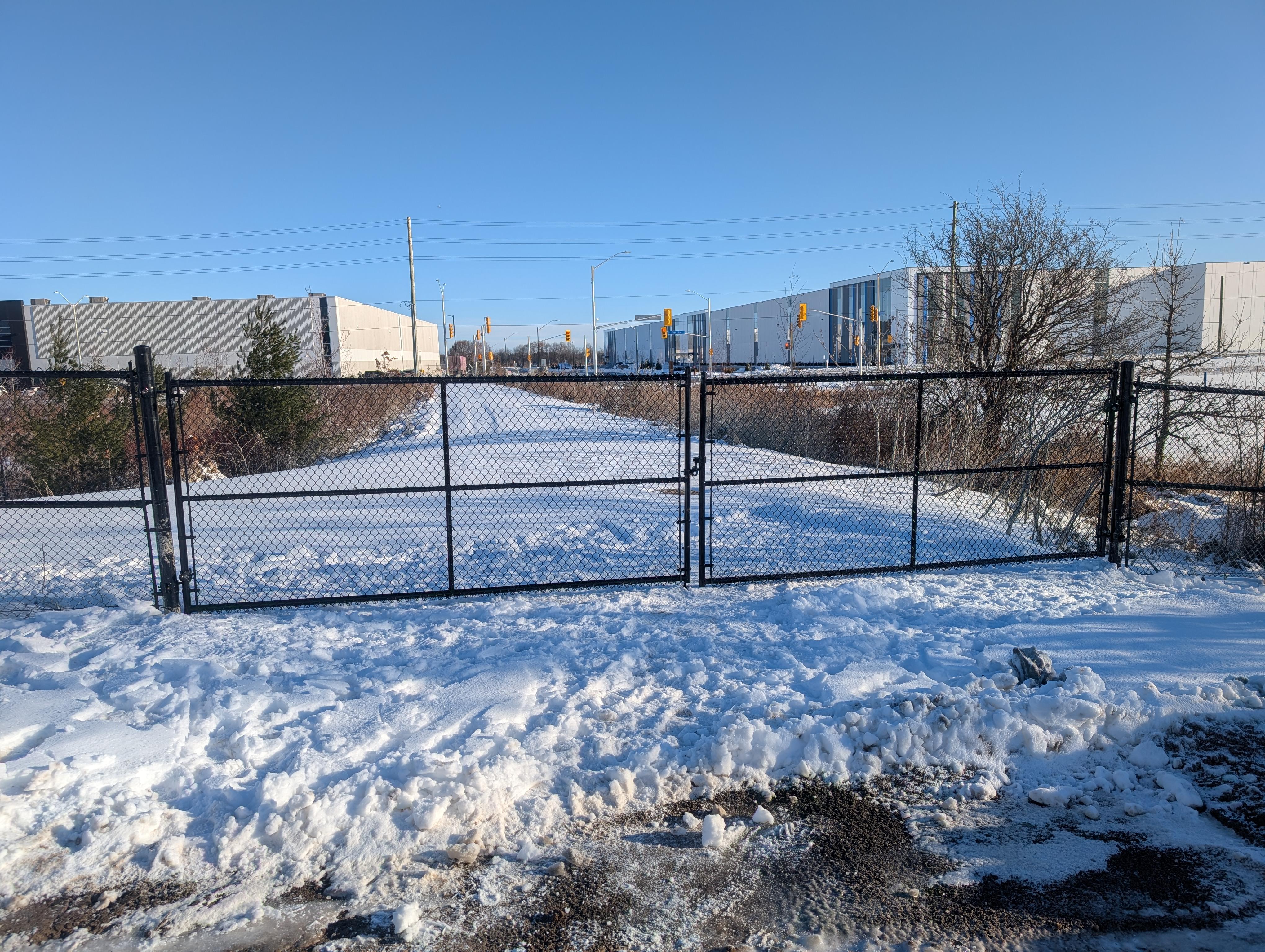
Chain link remains the default for a reason. It is cost-effective, visible, durable, and quick to install over long perimeters. For warehouses, storage yards, construction sites, and standard commercial lots, properly installed chain link with the right gauge and topper does the job. The key is installation quality, not material cost. Chain link fencing that is installed to airport-grade standards holds up for decades. Chain link installed by a rushed crew fails within a few winters.
Omega Fencing — When You Need Welded Security
Omega fencing is a welded mesh panel system that is significantly harder to cut or breach than standard chain link. The panels are rigid, which also makes them harder to climb. Omega is the go-to for schools, recreational facilities, basketball courts, and commercial properties that need higher security without the visual heaviness of expanded metal. The welded construction means there are no weak points in the fabric itself, and the panels bolt into posts with tamper-resistant hardware.
Expanded Metal — High Security for High-Risk Perimeters
Expanded metal is the step up from omega. It is a single sheet of metal that has been slit and stretched to create a diamond pattern, making it rigid, anti-climb, and extremely difficult to cut through with hand tools. Expanded metal is common around utility substations, detention facilities, and industrial sites where the perimeter has to resist active attempts to breach it. It is more expensive than chain link or omega, but for the right application there is no substitute.
Get a quote and Fencecore will recommend the fencing system that fits your property, your risk profile, and your budget.
What Airport-Grade Installation Actually Means
The Pearson International Standard
Installing fencing at Pearson International Airport means working to security specifications most contractors will never see. Post depth, material gauge, tensioning, topper alignment, and hardware all have to pass inspection. There is no room for a loose panel, an out-of-plumb post, or a gap at the base of the fabric. Fencecore has done this work, and the standard carries over to every commercial job we take on across the GTA.
Why This Matters for Your Commercial Property
Most commercial property owners will never need an airport-grade install in the strictest sense. But applying that standard to your property means your fence will actually function as a deterrent for the full life of the installation. It means posts that do not shift in the spring. It means tensioned fabric that holds its shape under stress. It means hardware that is not going to rust out in three years. You are paying for fencing either way. The difference is whether it is still doing its job in ten years.
Frequently Asked Questions
What's the most secure fencing option for a commercial property in the GTA?
It depends on the threat level and the budget. For standard commercial lots, heavy-gauge chain link with a barbed wire topper is typically sufficient. For higher-security sites, omega panels offer welded construction that resists cutting. For the highest security perimeters, expanded metal is the strongest option available. Fencecore will walk a property and recommend based on what the site actually needs.
What is omega fencing and when should I use it?
Omega fencing is a welded wire mesh panel system. The welded construction makes it significantly harder to cut or breach than standard chain link. It is commonly used at schools, basketball courts, recreational facilities, and commercial properties that need higher security without a heavy industrial appearance. It also installs cleaner than chain link for properties where aesthetics matter.
Can you install barbed wire or razor wire topping on commercial fencing?
Yes. Barbed wire is a standard commercial topper and we install it on chain link, omega, and expanded metal perimeters. Razor wire is available for higher-security sites where bylaws permit it. We check local zoning and municipal regulations before quoting toppers to make sure the installation is compliant.
How deep do commercial fence posts need to be in Ontario?
Commercial fence posts in Ontario should sit below the frost line, which means a minimum of four feet of depth in most of the GTA. Fencecore digs posts at four feet or deeper as standard. Posts set shallower will heave during the spring freeze-thaw cycle and pull the fence out of alignment within a season or two.
Fencecore Inc. offers free estimates for security fencing across the GTA — get a quote today and we will follow up fast.