
Sports Field & Recreational Chain Link Fencing GTA | Fencecore
Built for Constant Use
Overview
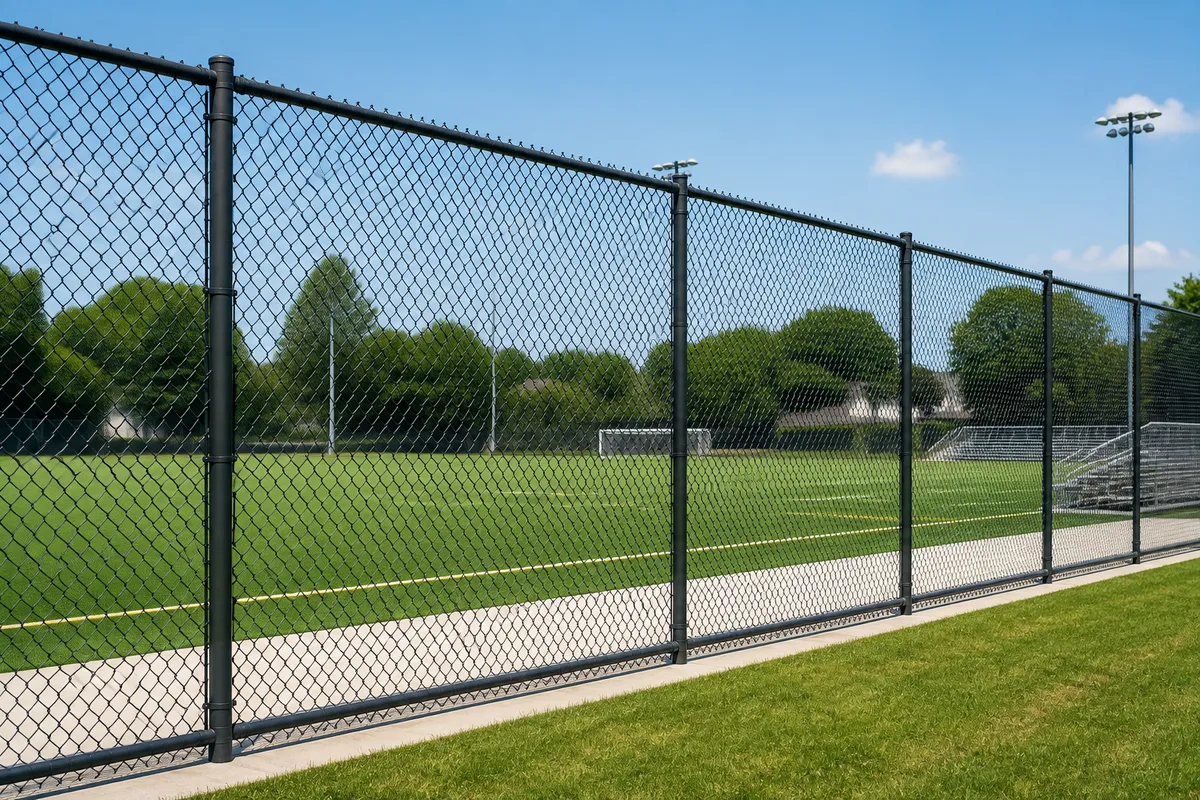
Recreational chain link fencing has to survive things residential fencing never sees: baseballs at speed, bodies hitting the fabric at a full run, gates opened and slammed a hundred times a day, and every freeze-thaw cycle Ontario delivers. That is why sports field and court fencing is specified differently, with heavier gauge fabric, larger diameter posts, tighter post spacing, and proper tensioning through top rails and bottom tension wire. Get any of that wrong and the fence bags out, the fabric ripples, and the facility is repairing it inside three seasons. Fencecore installs recreational chain link across the GTA to the same standard used on high-security and airport work, with posts set well below the frost line and fabric tensioned properly the first time.
Planning a field, court, or facility fence? Fencecore serves Brampton and an 80km radius across the GTA. Get a free quote to get started.
What Recreational Fencing Has to Withstand
Ball Impact, Weather, and Heavy Use
A backstop behind home plate takes direct impact from foul balls all season long. Every one of those hits transfers load into the fabric, through the rails, and into the posts and footings. Residential-grade chain link is not built for repeated point loading, and it shows: the fabric stretches, diamonds distort, and the whole panel starts to sag away from the line.
Tennis and basketball courts take a different kind of abuse. Less high-speed impact, far more continuous contact. Players lean on it, push off it, and run into it. Balls hit it constantly at moderate speed. Gates get used all day.
Then there is Ontario weather. Snow load pushes against the fabric all winter, ice adds weight to the top rail, and the freeze-thaw cycle works on every footing. A field fence is outdoors, unmaintained, and loaded for 20 years or more, which is why the underground work matters as much as anything above grade.
Height, Gauge, and Backstop Requirements
Height is driven by the sport. Tennis courts are typically fenced at 10ft to keep balls in play. Basketball courts commonly run 8ft to 10ft. Ball diamond backstops generally start around 12ft to 20ft behind the plate, with wings running down each baseline and often an overhang or hood at the top. Soccer field perimeters and running track enclosures are usually lower, often 4ft to 6ft, because containment rather than ball control is the goal.
Gauge is the specification most often quietly downgraded on a bid. Residential chain link is commonly 11.5 or 12.5 gauge. Recreational and commercial work typically calls for 9 gauge fabric, and high-impact areas such as backstops sometimes go to 6 gauge. The difference in cost is real but modest. The difference in service life is not.
Mesh size matters too. Standard 2 inch mesh is fine for perimeter containment. Tennis and pickleball often specify 1.75 inch mesh so balls cannot wedge in the diamonds. Post diameter, wall thickness, and spacing all scale with height, because a 12ft fence carries far more wind and impact load than a 6ft one.
Applications Across GTA Facilities
Ball Diamonds, Soccer Fields, and Running Tracks
Ball diamonds are the most demanding recreational install. The backstop is a tall, heavily loaded structure that needs deep footings and heavy posts, and the baseline wings need to be tied in so the whole assembly works as one unit rather than three separate fences. Overhangs and hoods add wind load and have to be engineered into the post sizing.
Soccer and multi-use fields are usually simpler perimeter runs, but the gate planning matters more than people expect. Maintenance vehicles, mowers, and equipment all need to get in, which means proper double or cantilever vehicle gates rather than an oversized walk gate.
Running tracks and the fields inside them are generally about controlled access and keeping the surface protected. Lower fence, more gates, and attention to how spectators and athletes actually move through the space.
Tennis, Basketball, and Multi-Use Courts
Tennis courts are the most specification-sensitive courts. Height, mesh size, wind screen provisions, and gate placement are all part of a proper court fence, and the fabric has to be tensioned evenly enough that it looks straight from the baseline. A rippled court fence is the fastest visual tell of a rushed install.
Basketball courts take heavy contact and benefit from stiffer systems. This is where omega panel fencing frequently comes in as an upgrade over chain link, since the vertical profile handles impact well and looks considerably better on a municipal or school property. Fencecore installs both and will say plainly which one fits the site and the budget.
Multi-use courts and pads that host several sports need fencing that handles the most demanding use they will see, not the average one. It is much cheaper to specify for that up front than to reinforce it after the first season.
Have a spec, a drawing, or just a site and a sport? Send it to Fencecore and you will get a straight recommendation and a quote back fast.
The Fencecore Standard for Recreational Installs
Post Depth, Tensioning, and Durability
Every recreational fence Fencecore installs starts below grade. Posts go 4ft or more below the frost line, deeper and larger for tall backstop assemblies, in properly sized concrete footings. That is the entire reason a fence is still plumb in year 15 instead of walking out of line after a few winters.
Above grade, tensioning is what separates a professional install from a fast one. Top rail through every line post, bottom tension wire, tension bars and bands at every terminal, and the fabric pulled evenly across the full run. Done right, the fence is tight and flat and stays that way. Done fast, it looks acceptable for one season and then bags.
Hardware gets the same attention. Galvanized or black vinyl-coated systems throughout, matched fittings, and gates hung on posts sized for the actual gate weight and duty cycle rather than the minimum that fits.
Working With Municipalities, Schools, and Facilities
Institutional work runs on process. Fencecore is used to installing to a written specification, coordinating around school calendars and facility bookings, and working on sites where the public is nearby and safety and cleanliness are non-negotiable.
The crew is union-trained through Local 183, and the installation standard is the one accepted for security work at Pearson International Airport. That standard does not change between a secured perimeter and a ball diamond.
Practically, it means the dates hold, the site gets left clean each day, and the quoted number is the invoiced number. For a facilities manager balancing several trades and a fixed budget, that predictability tends to matter as much as the fence itself.
Frequently Asked Questions
How much does sports field fencing cost in the GTA?
Recreational chain link in the GTA generally runs about $40 to $90 per linear foot installed for standard perimeter heights of 4ft to 10ft in 9 gauge fabric. Tall backstops and high court fencing cost considerably more per foot because of the heavier posts, deeper footings, and larger fabric, and a full ball diamond backstop with wings is usually quoted as its own assembly rather than by the foot. Gates, mesh size, coating, and site access all move the number, so every facility gets a fixed quote.
What gauge chain link is used for ball diamonds and courts?
Recreational and commercial installations typically use 9 gauge chain link fabric, compared with the 11.5 or 12.5 gauge common in residential work. High-impact areas such as ball diamond backstops sometimes specify 6 gauge. Tennis and pickleball courts often use a smaller 1.75 inch mesh instead of standard 2 inch so balls cannot lodge in the diamonds.
How tall should recreational fencing be?
Height follows the sport. Tennis courts are typically 10ft, basketball courts run 8ft to 10ft, ball diamond backstops generally start at 12ft and go up to 20ft or more behind the plate, and soccer field or running track perimeters are usually 4ft to 6ft since they are for containment rather than ball control. Municipal standards and facility requirements can set specific heights, so the by-law and the spec should both be checked before ordering.
Do you work with schools and municipalities?
Yes. Fencecore installs for schools, municipalities, and facility operators across the GTA, working to written specifications and coordinating around school calendars, facility bookings, and public access. The crew is union-trained through Local 183 and installs to the standard used on high-security and airport work.
Recreational fencing is a 20 year purchase, so the spec and the install standard decide what it costs you over that time. Fencecore offers free quotes across the GTA. Get a free quote today.


Premium fencing solutions across the Greater Toronto Area. Delivering quality workmanship, durable installations, and reliable service backed by 25+ years of experience.
About
Services
Residential Fence Installation
Gate Installation & Repair
Glass Pool & Deck Fencing
Commercial & Security Fencing
Service Areas
Brampton
Mississauga
Vaughan
Oakville
© 2026 FenceCore - All Rights Reserved.